After days in the barren desert or the dry Etosha National Park, Swakopmund offers a welcome respite. This coastal town on the Atlantic Ocean has excellent infrastructure and is ideal for a relaxing stopover. A stroll around town will reveal many surprises in this small corner of Africa.
Why visit Swakopmund?
Swakopmund Highlights
- Ideally located on the West Coast of Namibia, prime holiday destination
- Modern town particularly tuned to servicing the tourism industry
- “Adventure Capital” of Namibia, with a large number of activities and excursions on offer
- Excellent accommodation options from hotels to B&B’s & self-catering
- An array of fantastic restaurants in unique settings
- German architecture, museums, galleries, craft markets
In Africa, It's Not About What You Know, But Who You Know.
We've partnered with the best to ensure you get front row seats at the best possible price.



Item 1 of 4
Where To Stay in Swakopmund
Not all Swakopmund properties are created equal! Our Travel Experts have slept in these beds and are thus well-equipped to match your individual needs and requirements!

Item 1 of 5
Property of the month
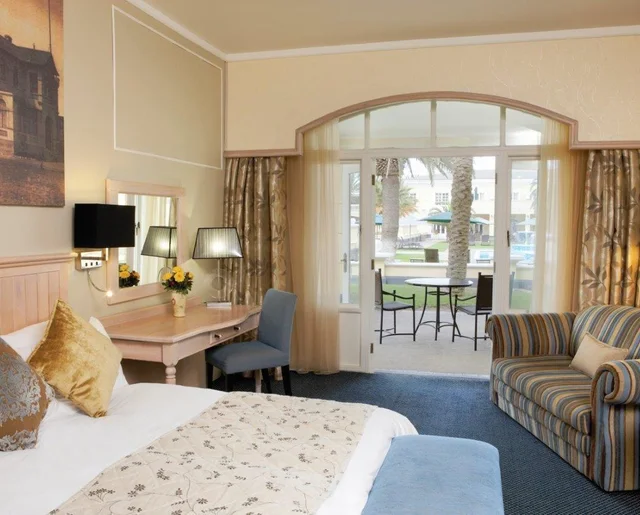
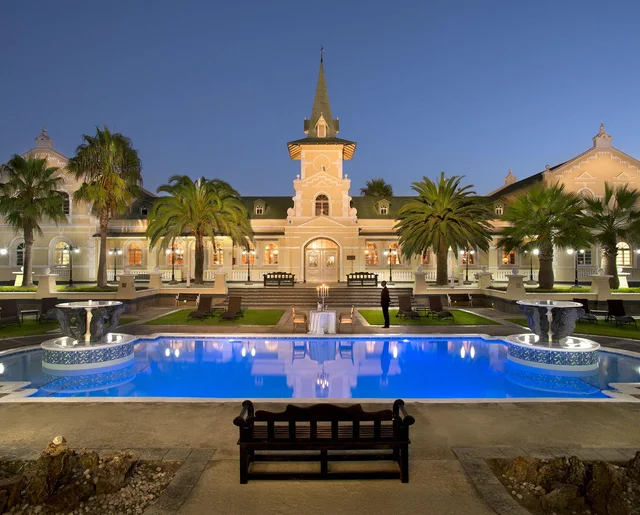
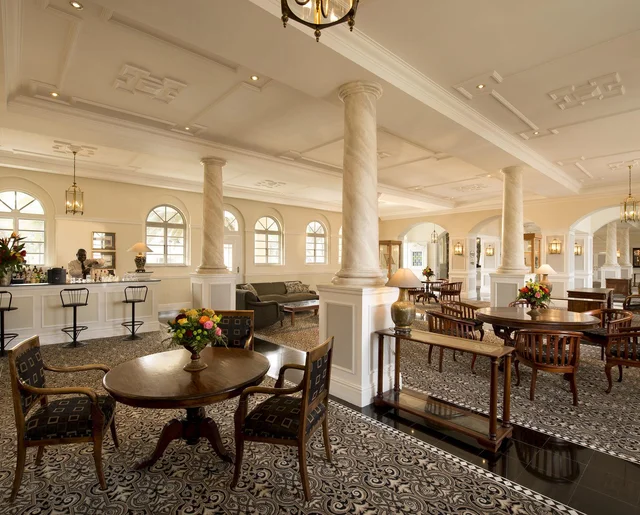
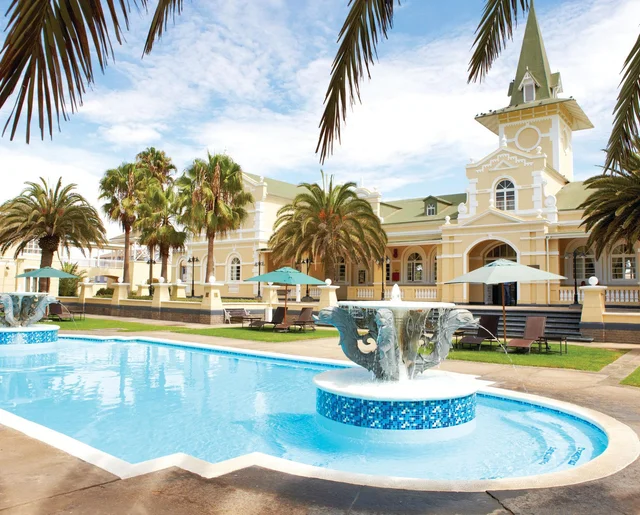
Swakopmund Hotel and Entertainment Centre
Architectural beauty with first-world comfort
View the propertyFrequently Asked Questions
We've taken the liberty to answer everything you may need to know about visiting Swakopmund
The National Carrier, Air Namibia, flies directly from Frankfurt to Namibia. They also offer daily flights from South Africa (from Cape Town and Johannesburg), Zimbabwe, and Botswana to Namibia. Travellers can fly to the International Airport in Windhoek, called Hosea Kutako, and transport to their chosen destination within Namibia.
By road, Swakopmund is about a four-hour drive from Windhoek. The smaller Eros Airport, just outside Windhoek, is used mainly for charter flights to Sossusvlei, Swakopmund, and Etosha. The closest airport to Swakopmund is in the town of Walvis Bay, a 30-minute drive away.
The answer is...yes! It's very easy to drive yourself from Windhoek to Swakopmund and throughout Namibia. It's also very scenic, so remember your camera for those pit stops! Roads are relatively in good condition, but we do recommend a 4x4.
Founded in 1892 when the Germans colonised Namibia, Swakopmund has retained much of its European influence with German cuisine and architecture. You'll also find that most of the locals speak fluent German. However, beyond this charming town, Namibia is home to a surprising variety of cultures and traditions for such a sparsely populated country. These include many local tribes such as San People, the Nama, Damara and Herero.
The currency in Namibia is the Namibian Dollar, which is fixed to and equals the South African Rand on a one-to-one basis. The Namibian Dollar and South African Rand are the only legal tender in Namibia and can be used freely to purchase goods and services. The Namibian Dollar, however, is not legal tender in South Africa.
Traveller's cheques and foreign currency can be exchanged at any commercial bank, which you will find throughout the country. Visitors may bring any amount of foreign currency into the country. Further information and assistance can be obtained from any commercial bank in Namibia.
Surrounded by the Namib Desert on three sides and the cold Atlantic waters to the west, Swakopmund has a desert climate with mild conditions year-round, making it a wonderful place to stay. The average temperature ranges between 15°C to 25°C. However, if you are combining Swakopmund with a well-rounded trip to Namibia (as most people do), here is more information regarding the country's climate as a whole.
Summer
From November to April, days are generally hot and sunny. Daytime temperatures can rise to 35ºC (above 40ºC recorded in the extreme north and south), and night temperatures drop to around 14ºC - 18ºC. The coastal region is cool and dry throughout the year. The rainy season runs from February to March, and average rainfall varies from less than 50mm along the coast to 350mm in the central region and 700mm in the far north-eastern region.
Winter
Between May to October, days are dry, sunny and mild to warm while evening temperatures drop sharply. Daytime temperatures generally reach 23ºC and can drop to as low as 0ºC - 10ºC at night. It can be pretty cold and windy at the coast, for which warm clothing and a windbreaker are necessary.
Discovery in 1892
The Imperial German colony required a main harbour that had an easy connection into the centre of the South West African territory, particularly the Otjimbingwe and Windhoek. The natural deep waters at Walvis Bay were ideal but belonged to the British at the time. A little further north from the British port, Swakopmund was founded in 1892 by Captain Curt von Francois. It was chosen for its freshwater availability and quickly became the main port for imports and exports for the whole territory.
A name peculiar in nature
Many towns in Namibia have developed out of indigenous settlements that were located near water sources. The names of these places – given by original inhabitants - were very descriptive and often retained by European settlers who put their spin on the pronunciation. The word ''Tsoakhaub'' in the Nama language can be translated as ''excrement opening'', which was a rather revolting but accurate description of Swakop River at the time. When the river would flood, masses of mud, sand, pieces of vegetation and dead animals would funnel through and flow into the ocean - the indigenous name described it very well. Eventually, the Nama name was changed to ''Swachaub'' and, with the proclamation of Swakopmund as an independent district in 1896, the present spelling came into use.
World War I
Early in World War I in 1915, German South-West Africa was taken over by the Union of South Africa. The logistic and political barriers disappeared to use the harbour in Walvis Bay for South West Africa. In Swakopmund, all harbour activities ceased, businesses closed down, the number of inhabitants diminished, and the town fell into decline.
Revisioned and renewed
A few years following World War I, Swakopmund was given a lifeline in a 1923 treaty in London negotiating the aftermath of the war. Thanks to its moderate climate and seaside setting, the town was re-shaped into a tourism destination. Having lost its military importance, Swakopmund was used for recreation even during World War II, and in the 1940s and 1950s, it expanded to serve more and more tourists.
Namibian Independence
In 1990, after Namibian independence from South Africa, many street names were changed from their original German, or in some cases, Afrikaans names, to honour Namibians, predominantly Namibians of black heritage. Regardless of a turbulent past, this charming town still retains much of its European influence, as well as a delightfully distinct German flavour.